Monday, July 20, 2009

Illustrations of Hood Pathology


Quite often I'll walk past the garbage bins in front of my building and get the bum's rush courtesy of the overwhelming ammonia smell of urine. I always wonder, "Who is peeing in the trash?" I always hope that it's maybe stray cats or some other animal, but I know it's probably some dude.

Well the other night I came home from a party sometime in the early morning and saw some dude who most likely lives in my building, taking a whiz right in the garbage bin area. He couldn't be bothered to go upstairs to his apartment. Nor could he bother to use a tree or perhaps the sewage drain in the street. No, he had to pee in a heavily trafficked common area. Why? I guess for the same reason you have the pervasive "piss in the elevator"-phenomenon found in low-income housing complexes; the same reason I find less vigilant dog-curbing in my neighborhood; the same reason people flagrantly toss food wrappers and other debris on the sidewalks of the neighborhood they live in. I see it as a lack of self-respect. If you don't value the environment that you inhabit, then you don't much value yourself. That's of course much too simplistic a view, but I think there is a grain of truth in it.

Movie Recommendation--Sorta


Hancock is not a good movie, per se. I do think it's an interesting failure worth viewing. The film starts off well enough with an interesting premise that gets explored for roughly a half-hour before the plot throws a curve-ball. It could have worked, but the movie tries to shoehorn everything into 90 minutes, thus giving short shrift to the complexities of the situation as presented.

One of the mysteries the movie puts out there is the origin of Hancock. As an amnesiac, Will Smith's anti-hero (if you can even call him that) struggles with questions of identity. Great, I can roll with that. When we finally find out who he is, the why's and wherefore's, I was a bit surprised at the subtext the writer weaved into it. It was bold, but that also made it problematic. The issue with Hancock's origin reveal is that the film isn't constructed in a way to support the weight of it. Nothing that precedes it suggests that the film will aspire to anything more than your typical lightweight action flick. I actually found Charlize Theron's monologue in which she explained Hancock to himself quite moving, but it belonged in a better movie.

I hear a sequel is a possibility. Perhaps the creative team involved can make good on the potential the concept holds.

Michael Bay is the Future

At the time of this post, Transformers 2: Revenge of the Fallen has grossed approximately $310 $364 million dollars domestically and an additional $326 $383 million dollars in foreign box office. Less than a month into its run, that puts it at #26 #13 and #36 #28 for all-time unadjusted gross, domestic and worldwide respectively. It will undoubtedly move up a number of slots before its run is completed. It’s plausible inevitable the film could will break into the top ten, domestically speaking. I’ve concluded from this that Michael Bay’s career may be the strongest case against democracy the world has ever known.

Michael Bay. He is the proverbial scorpion on the back of the frog. He makes us complicit in the death of our own good taste. Bay acts as a pop cultural Satan who gets us to lower our standards just a tiny fraction each time out. And what do we do? We drop a few more coins in his palm and smiling glassy-eyed ask him to do it again.

I remember going to see Armageddon over a decade ago at the behest of a friend who was a great admirer of both Bad Boys and The Rock. After the film he turned to me with a grin and started laughing almost with tears in his eyes and then summed up his feelings on that film with a slew of invectives. I'll admit I thought the film was serviceable with a few moments of inspired lunacy (space madness? lifetime income tax exemptions?). Little did I know I was only encouraging Bay to continue. Years later I had the misfortune of watching Bad Boys 2 which I found not just crude in its execution but racially offensive which is no minor feat since one of the leads was Will Smith (I'm recalling the scene where this kid comes to take Martin Lawrence's daughter out on a date--Roger Ebert makes special note of it in his review). I caught his film The Island on DVD, I think. I found it to be his least offensive film. It was nonetheless a mediocre effort marred with Bay’s signature desultory chases and explosions. The man doesn't seem to strive to make films so much as cinematic energy drinks.


I don’t mean to say he is without talent. He at the very least has an eye. You could take stills from a number of his films that would rival the work of Annie Leibovitz. Bay is an auteur without question. I would call his particular style Brutalism (apologies to any architects). He assails the viewer with a wearying combination of visual and aural concussive bursts. Some viewers find this stimulating, exhilarating even. In small doses I find it tolerable, but extended beyond say an hour, I just find it exhausting. I become numb to whatever is unfolding on the screen trying to pass for a story. His characters have no internal complexity. His films often lack internal logic and flout the external variety. Apologists often say he's just making fun movies. But that's just it: His movies are not fun.


Amos and Andy in the 21st Century
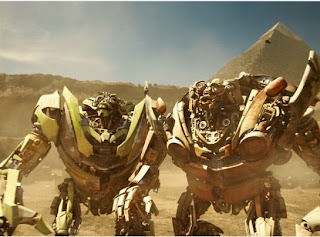
Transformers 2: Revenge of the Fallen finds Bay at his absolute most indulgent worst. I went in with the lowest expectations for the movie and somehow it managed to undercut even that. I knew I was in for an interminable experience when the first words I heard Optimus Prime utter were: "Punk @$$ Decepticons." It would only go downhill from there. The film is an endurance test and I almost failed. I could have walked out and felt no shame (the only other movie I ever almost walked out on was Rush Hour 2; Brett Ratner is bar none America’s worst working director).

The film is super-saturated with action sequences, which is to be expected, but the bulk of them are completely unintelligible from a visual or logistic point of view. Imagine watching action scenes from The Bourne Identity, but replace Matt Damon with ILM’s hyper-articulated (and downright ugly) CGI robots. I defy anyone to make sense of 90% of the fight-scenes in this movie. At some point it’s just random bits of ornate metal smashing into each other and splintering into more pieces. No attempt is made to imbue any of these creations with character or soul. That goes for both organic and inorganic creatures in this film. The result is action that fails to resonate at all; it's a paradoxically inert spectacle.

I was disappointed to find the screenwriting team responsible for the new Star Trek also penned this dreck. I found that film immensely enjoyable and smartly designed. There is no point rehashing the plot of TF2, because it’s utterly meaningless to the proceedings. The dialogue as noted above is at turns offensive, vapid and cliché (in many some cases a combination of all three). And the less said about the two Sambo-bots: Mudflap and Skids, the better. I will just note how disappointed I am that Steven Spielberg’s name is on this flick. It would seem he had no issue with a film that prominently features two Gremlin-faced, simian-looking, jive-talking, foul-mouthed robots (one sporting a gold tooth, no less) both of whom are apparently illiterate. I hold this against Spielberg even more so than the surprisingly flaccid and disappointing Kingdom of the Crystal Skull.

So all this terrible dialogue, frivolous plotting, and incoherent action rumbles along for over two-and-a-half hours, daring the audience to revolt against it. Yet, at the end of the screening I attended on opening day, people actually applauded. I was dumbfounded. I understand art is subjective, but some things are just inarguable. How anyone in the audience felt a connection to anything that transpired on that screen is beyond me.

The only way I can explain it is that the film is pornography for the action-junkie set. It arrives at its goal in the most artless and brutal way possible. I wonder if people who enjoyed this movie felt shame afterwards? God, I hope so.

Of course Bay is not the sole villain here. He is merely the most successful. The past decade has been commercially ruled by Jerry Bruckheimer, producer of the bloated and boring Pirates of the Caribbean sequels, the derivative National Treasure films and his mind-numbingly repetitive television work. Bruckheimer and his ilk, the Stephen Sommers' (who will inflict more pain on our cortices this summer with GI Joe) and McG's of the world, hold the reins. This is the entertainment we flock to and I just don't understand it. We've created a generation that thinks Terminator 2 is a better film than Terminator; that Jaws is boring (yes, somebody actually argued this to me); that Transformers 2 should get a pass because it's got cool effects. Aesthetics in a bare-fisted, knockdown brawl against good story-telling--and it's been no contest. Films like Transformers 2: Revenge of the Fallen are sins against Creation. And the sooner the movie-going public at large recognizes this, the sooner our redemption can begin. Please, WTFU.

And this sums up everything I've been trying to say:

Sunday, July 12, 2009

Being a Maverick Means Never Having to Say You're Sorry


"You have sustained personal torture, personal attack, political attack, investigation," Gregory said. "You have never resigned from anything. Is it consistent with your qualities of leadership to resign an elected post like this?"

"Sure," the senator said.

"It is?"

(BTW, it would be so nice if our media superstars had just a hint of testicular fortitude)

Here's my thing: We know you're full of $#!t, you know you're full of $#!t. Why continue to bull$#!t us? Just offer the mea culpa and try to salvage your legacy just a bit. We know you have to be steaming on the inside that this woman has cemented you as a politician with the worst judgment in history. Why is it so hard to say: "You know what? I messed up. She was totally unqualified and I took a gamble that was wholly inappropriate. I'm sorry." Why, John? Is there a 'mercy rule' we can invoke for the GOP? The slide towards irrelevancy continues unabated.

Saturday, May 16, 2009

The He-Man Woman Hater's Club Circa 2009


I direct you here. It is a long interview, but well worth your while. The interviewee is Elizabeth Warren, chair of the Congressional Oversight Panel "charged with the job of reviewing the state of the markets, current regulatory system, and the Treasury Department's management of the Troubled Asset Relief Program" (as per Wikipedia). Ms. Warren is a law professor at Harvard University. For over three decades she has researched the shifting landscape of our economy and its effects on the middle-class, written several books and authored dozens of academic papers. The interviewer is Adam Davidson, co-host of NPR's Planet Money, a nifty show that aims to demystify some of the more technical and esoteric concepts in the financial industry such as complex derivatives and credit spreads for the lay person.

The interview begins well enough as Davidson lets Warren explain what her panel does and how it came about. Perhaps five minutes in, he begins breaking the cardinal rule of interviewing and makes the interview about himself and his views. It's not bad to pose challenging questions to the subject of your interview, but he starts attacking the very existence of her committee. From there Davidson adopts an adversarial posture throughout the rest of the interview. He thinks her viewpoint (which both agree is not a centrist one) is invalid. He does not consider her "serious."

Mr. Davidson's tone even deteriorates into condescension at times. Despite his claim that he's projecting his anger at Harry Reid and Nancy Pelosi on Warren and that she is not the true target of his ire, it is quite clear that he does not respect her as an intellectual. A number of times Warren attempts to bring a calmer tone, but Davidson insists on ratcheting things up further at one point stating "I want to make you madder." (Ms. Warren would have been well within her right to defenestrate Mr. Davidson at that point if it were possible.) Warren to her immense credit responds passionately but keeps her arguments both lucid and cogent. (That's the trick you see: make your opponent seem unhinged and irrational so that their views can be discounted.) Here is a key exchange a bit past the hour mark:
DAVIDSON: The American families are not -- These issues of crucial, the essential need for credit intermediation are as close to accepted principles among every serious thinker on this topic. The view that the American family, that you hold very powerfully, is fully under assault and that there is -- and we can get into that -- that is not accepted broad wisdom.

ELIZABETH WARREN: Whoa--wait, wait. Remind me who it is who thinks that wages have not stagnated, that unemployment is not up, that debt levels are not up, that savings are not down, that the net worth of the American household just in the last eighteen months has shrunk by twenty percent. I'm sorry those are Federal Reserve numbers. This is not a question of 'your numbers, my numbers'. We're not making this up. We didn't get these out of a Cracker Jack box. These are numbers that anyone who reads the numbers, they're there.

DAVIDSON: We're in a severe recession.

WARREN: Well so what is the part that is controversial? Everybody thinks, that means it's good? That you can make your payments? I don't know what world you live in here. The default rates are rising. That means the income is not there. The credit will not work in a system like that. We have to think about all of the parts.

DAVIDSON: But that view is--I talk to a lot a lot a lot of left, right, center, neutral economists [and] you are the only person I've talked to in a year-and-a-half of covering this crisis who has a view that we have two equally acute crises: a financial markets crisis and a household debt crisis that is equally acute in the same timing way. I literally don't know who else I can talk to support that view.

WARREN: You know I don't know what to say at that point. The numbers are the numbers. The fun--

DAVIDSON [interrupting]: And you are uniquely right.

WARREN: The fun stuff is to look at the big banks and how we've moved around billions of dollars there.

DAVIDSON: Nobody's trying to have fun. What are you talking about? We are talking about a system that the basic plumbing is dying. And maybe they approached it right. A lot of people, probably more people, think they've approached it wrong, the administration. This isn't about the administration actually what I'm saying. I literally don't know anyone other than you who has that view, and you are the person [snicker] who went to Congress to oversee it and you are presenting a very, very narrow view to the American people.

WARREN: I'm sorry. That is not a narrow view. What you are saying is that it is the broad view to think only about trying to save the banks [Davidson sputters] and say Hey! the American economy will recover at some point and we'll worry about the families [Davidson talking over]. I think that is the narrow view and I think I have the broad view. The broad view is that these two things are connected to each other. And the notion [DAVIDSON: And are equally acute? And are equally acute?] that you can save the banking system while the American economy goes down the tubes is just foolish.

Davidson continues to pursue his "serious people aren't advocating such a position"-argument, implying that Professor Warren doesn't deserve a seat at the table. The gist of his argument is that this financial crisis is so acute that the focus should be squarely on the banks. He completely divorces any real-world implications in the way the bailout is undertaken. At one point he says, "nobody cares about this." I suppose the 8.9% of unemployed Americans, the 40 or so million without any health insurance, the majority of the workforce that have seen their wages stagnate for the past two decades, those on the wrong end of the ever-widening wealth gap, I suppose their voices don't matter in any "serious" conversation.

The idea that somehow people outside of banking and finance should have no say, as Warren points out, is absolutely ludicrous. Yet this is how our media tends to think. When the red lights are flashing, there is no time for introspection. Just get out of the way and let the professionals handle it. There was no serious push-back against the war in Iraq because the country was in a state of emergency; no push-back against torture because we were in crisis-mode; no push-back against the egregious erosion of the civil liberties of our own citizens because these were (and continue to be one assumes) desperate times. And anyone who tries to slow that train, obviously has an agenda. Obviously.

I encourage people to listen to the full interview. It is perfectly illustrative of how our media operates. Everything must be viewed through the lens of partisanship. Meanwhile the media is the objective centrist that never takes sides. Everything comes down to how one can be categorized and their opinion subsequently marginalized. Oh she can't be taken seriously because she has such liberal-partisan views! There is no way we should question how the TARP is being utilized or what the banks are doing, we're in a crisis people! Oh we can't listen to people asking for the rule of law to be upheld and torture-architects to be punished because they're on a partisan witch-hunt. We can't criminalize policies that were, uh, criminal. We can't ask our rulers, I mean politicians and CEOs, to explain themselves or hold themselves to the same laws that we do. That's just comical.

People like Davidson whether consciously or not see themselves as elites. They see the world as divided into the serious and the unreasonable who ask for things like "transparency" and "accountability." They look at people arguing for such things as a source of theater but nothing more. The elite don't have an agenda other than preserving the status quo. They believe they always know what's best even if they go about things haphazardly. Davidson believes that Paulson, Geithner, et al, despite mistakes they may have made are really the smartest guys in the room with the best intentions. So what if tens of billions may have been misappropriated or some of the money can't be accounted for at all or if the American public got a raw deal or that the individuals most responsible for creating this mess are cloistered away behind closed doors making the decisions for all of us. Just hand us the check and keep your mouth shut. These people know what's best for us and if you question that, you are not serious.

Monday, March 9, 2009

What's Wrong With This Picture?


When I first heard that “Watchmen” was finally getting the greenlight and that Zack Snyder fresh off the commercial success of “300” would helm the project, ambivalence was the only feeling I could muster. “300” wasn’t a completely unpleasant way to spend a couple of hours. I respected it more for its technical accomplishments than anything else (visually, Snyder produced champagne with beer money). “Dawn of the Dead” I loathed on general principle. You don’t need to remake the best zombie movie ever IMNSHO. And the "innovative" idea to have agile zombies was just spit in George Romero's eye. It wasn’t especially original either, since Danny Boyle did it (better) in the uneven but solid “28 Days Later”. So suffice to say, I didn’t have much confidence that Snyder could transition the source material into a self-contained fully-realized piece of cinema that could stand on its own two legs. The first crop of trailers further deepened my skepticism. Would we get three hours of brutal slo-mo action sequences, perhaps another goofy slo-mo sex scene? Um, yes and yes.

I don’t think there is anything inherently “unfilmable” about "Watchmen". I read Alan Moore’s deconstructionist take on the superhero perhaps a decade ago. There is no doubt that it is a canonical text in the comic book world; it has a place reserved in the pantheon next to Frank Miller’s "The Dark Knight Returns", Gaiman’s "The Sandman" and Garth Ennis’s "Preacher". These works were the foundation of the contemporary comic book. The source material deserves every bit of respect that it's received. "Watchmen" sprawls over twelve issues and spins a wide narrative web; the book's tangents go on tangents. This might seem daunting, but the story has a very clear through-line. It is essentially a detective story told by the paranoid borderline psychotic Rorschach. It has a clearly delineated three-act structure. The book takes the scenic route to get where it's going and I wouldn't want it any other way, but the film doesn't have that luxury nor should it.


The biggest issue Snyder has is that he’s far too reverential towards the source text. Hell, Cecil DeMille took more artistic license with the Ten Commandments than Snyder does with Moore’s "Watchmen." The most glaring issue is that transferring entire swaths of dialogue from the graphic novel does not a good screenplay make. As Anthony Lane points out in his New Yorker review (his review sucks, btw; I don’t know why he or Denby for that matter even review films; they both seem like they hate movies for the most part)--you can’t have characters (even right-wing nutjobs like Rorschach) spouting lines like: “The city screams like an abattoir full of retarded children.” Yes that’s from the original text, but that doesn’t make it, you know, good.

The second major issue is that Snyder fails to capture the mood almost entirely. I’m more forgiving here, because his task was so awesome. How to capture the existential dread of the mid-eighties at the zenith of the cold war and nuclear posturing on both sides of the Iron Curtain? I remember being subjected to fear-mongering propaganda like “The Day After” which is to this day one of the scariest films I’ve ever seen. There are still images seared into my brain decades later like the poor dog digging up the kitchen floor in a vain search for food after the family had abandoned it for the basement shelter post nuclear holocaust. Damn you, Reagan!


Watchmen is set during this period and we see these scenes where tactical decisions are made and the Doomsday Clock moves closer to midnight, but we don’t feel it. We’re as detached from the ordinary citizens as Dr. Manhattan. We don’t spend enough time with the alternate world to really grasp what’s going on. One minute Dan and Laurie are having a nice dinner in a restaurant, the next people are rioting in the streets. Why? If people are rioting, why is Nixon serving a third term? Is America supposed to be a fascist nation? It’s not really clear. It's also not clear what this Watchmen group represents. We're given a couple of flashbacks to photo shoots of team pictures and a couple of Watchmen dispersing a riot, but that's all. There's no sense as to what the Watchmen meant to the world or even to each other. For the unconverted the proceedings on the screen must be terribly bewildering and/or numbingly boring. Why should anyone care about these characters? Not just the superheroes, but anyone? The film doesn't even try to answer that.

To make matters worse, the acting save for a few characters is uniformly atrocious. It’s as if they got Hollywood money to make the flick and populated it with actors that would be mediocre in a Sci-Fi Channel original movie. Malin Akerman who plays the Silk Spectre II seems lost from the very first scene and never recovers; unfortunately she gets probably the second most screen time after the superb Jackie Earle Haley (more on him later). Matthew Goode as Ozymandias comes across as the world’s most obnoxious prick as opposed to the smartest man (which might be fine in another film, but it's a complete mischaracterization of the graphic novel version). I found the Comedian’s performance to be uneven, but again the bad dialogue kneecaps him (see: Vietnam bar scene). Physically (with the exception of Goode's Ozymandias--too scrawny) the characters are three-dimensional doppelgangers of their print counerparts. Sure Patrick Wilson's Dan/Nite Owl could have been a bit paunchier, but he pulls off "middle-aged schlub" quite well. He and Jackie Earle Haley give the movie some desperately needed heart and humanity.

Some positives on the acting: Billy Crudup does about as much as one can do with Dr. Manhattan considering his performance is comprised mainly of voice over (still his few "in the flesh" bits manage to sell the tragedy of Dr. Manhattan with just a handful of scenes). Matt Frewer pops up in a minor but important role; made me smile to see good ol' Max Headroom on the big screen. Carla Cuggino as Sally Jupiter enlivens things in her few scenes, but I kept thinking why not let her play Silk Specter and just get an actual old lady to play Sally? On a related note, all the aging makeup is terrible. And the prosthetics for the actor playing Nixon are distractingly bad. No one got an inkling how bad this stuff looked from the dailies? Jeez. Anyway, Patrick Wilson as the somewhat pathetic Dan manages to create a character the audience can really invest in. Dan/Nite Owl actually comes across as a complex fully-fleshed out character as opposed to the other characters who are given a great deal of expositional baggage, but still feel rather one-dimensional.


Jackie Earl Haley as Rorschach manages to avoid that fate seemingly through force of will. As I mentioned before, he's saddled with some of the most ham-fisted dialogue in the movie, but for the most part he makes it work. He easily monopolizes the movies best scenes including the prison sequence (I still don't understand why there was a riot) and his confrontation with Dr. Manhattan at the film's end. His performance equals Ledger's turn as Joker in terms of truly capturing the essence of a well- established literary character on the screen. I'd honestly sit through the film again (on DVD) just to watch his portrayal of the schizophrenic love child of Philip Marlowe and William F. Buckley.

The word is that Zack Snyder has an extended cut that adds on at least an additional half-hour to the movie. I suspect that cut will be even worse. If I could tell the "visionary director of 300" (as the trailers dramatically intone) one thing, it'd be that what's missing from the film is not more elaborate subplots; what's missing is a vision.

A few notes: unless you’re filming an episode of The Red Shoe Diaries, a slow-motion love scene is completely risible; Tears for Fears "Everybody Wants to Rule the World" should never be used without irony in a film; gratuitous explicit violence is not inherently more real or potent than tastefully cutting away and leaving something to the imagination.

Final note: The one place Snyder does show some inventiveness is the new ending. It works. In fact it works better than Moore's original ending. If it were a better film, I'd be writing about the film's subversive commentary on religion. If it were a better film. Too bad.

Tuesday, February 10, 2009

"And While You're Shaking My Right Hand, I'll Stab You With the Left"


Last night as I listened to Obama's press conference, I found myself rejoicing in the idea of having a president who might actually meet the demands of the office in both temperament and intellect.

It had been so long since the man standing behind that podium inspired confidence in me that I'd forgotten what it felt like. Obama's words were direct and his answers contained only a minimal amount of evasiveness. I was so relieved, overjoyed almost. Then I read this and the euphoria dissipated. In light of Mr. Obama's FISA vote as a senator, I guess this shouldn't be too much of a surprise.

The most egregious behavior the Bush Administration sanctioned and encouraged will continue to be a stain on this country and no amount of "looking forward" will change that. Whether or not abuses happen at the highest levels of government should not be dependent upon how honorable the people in office are. Our laws mean nothing if they don't apply to everybody and I don't think there is any hyperbole in saying that. The President failed a huge test yesterday. I doubt the MSM will cover it either. They'll be too busy dissecting last night's press conference. Meanwhile, the real news will be relegated to a blurb on page three. And so it goes...